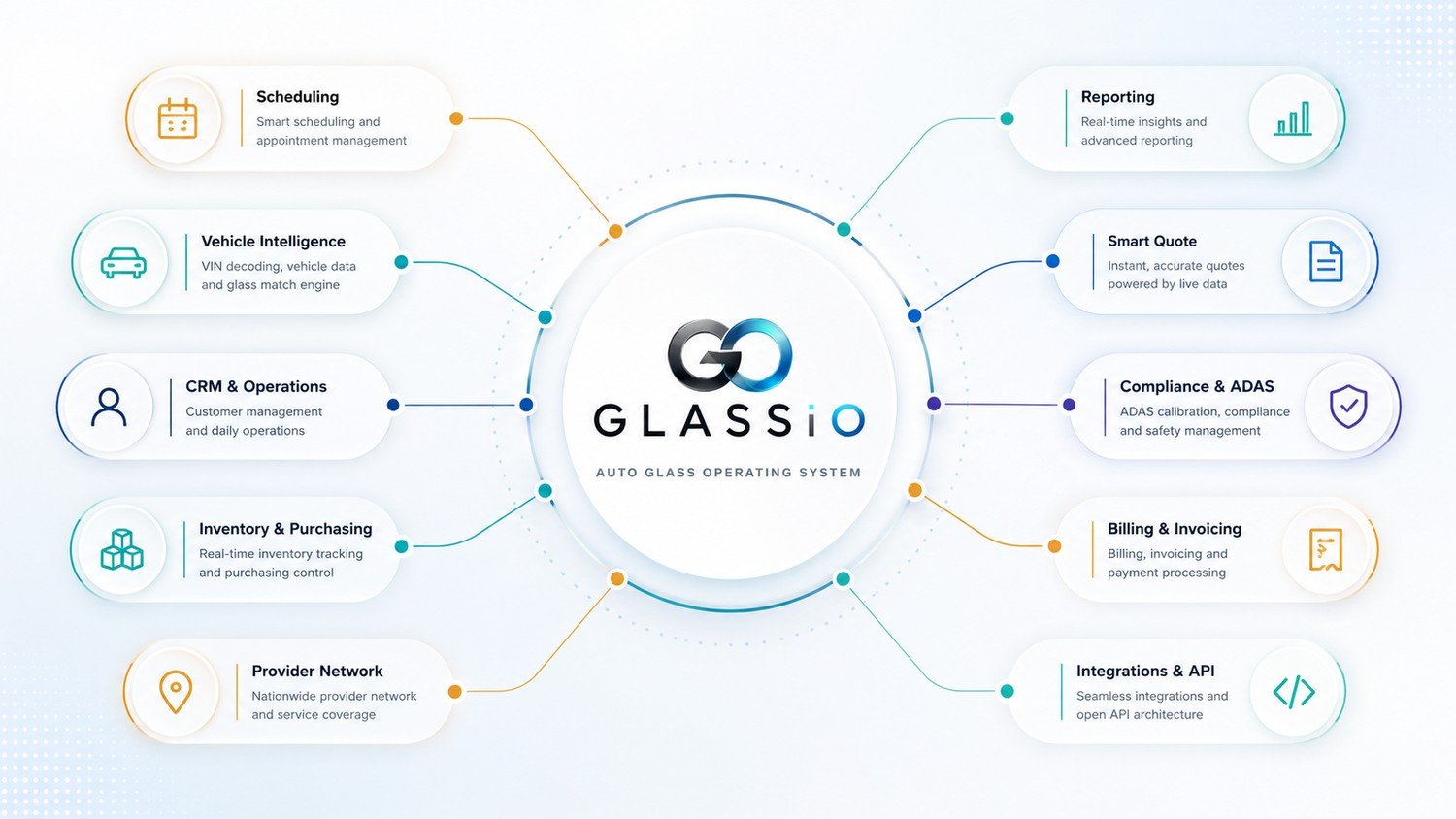
One connected operating system — every auto glass workflow on a single platform.
Glassio was created to connect the critical workflows auto glass businesses rely on every day, from vehicle intelligence and scheduling to inventory, purchasing, compliance-related processes, billing, reporting, and marketplace visibility.
Most business software starts as a generic CRM, field service tool, or inventory system and then tries to adapt itself to auto glass. Glassio starts from the opposite direction. We begin with the operational reality of the auto glass industry and build software around the workflows that actually matter.
One connected operating system — every auto glass workflow on a single platform.
Glassio was not created because the world needed another CRM. It was created because auto glass businesses face operational problems that generic software does not understand.
Every job starts with a vehicle. Every vehicle may have specific glass requirements, sensors, options, calibration considerations, supplier availability, pricing variables, and scheduling constraints.
Modern auto glass operations require accurate vehicle information, supplier coordination, inventory awareness, and workflow visibility.
Generic systems leave teams switching between software, portals, spreadsheets, and manual processes.
A purpose-built operating system connects the workflows that matter most.
Vehicle Intelligence, CRM, inventory, purchasing, compliance, reporting, and provider network workflows become part of one connected system.
Auto glass businesses are operationally complex. They are not just selling appointments. They are identifying vehicles, interpreting features, sourcing parts, managing mobile and in-shop work, coordinating technicians, communicating with customers, handling billing, tracking documentation, and making decisions based on incomplete information.
Glassio exists to reduce that complexity by replacing disconnected processes with connected workflows.
Bring the core workflows of an auto glass business into one platform.
Help teams use vehicle data, operational status, and reporting to make better decisions.
Minimize duplicate entry, scattered records, and disconnected processes.
Support mobile installers, shops, distributors, and enterprise organizations.
A traditional CRM may store a customer record, but it does not understand vehicle fitment, ADAS-related considerations, supplier inventory, safe drive-away documentation, mobile installation scheduling, or job-aware inventory reservations.
Modern vehicles include sensors, cameras, HUD systems, rain sensors, ADAS features, and fitment considerations.
Shops often rely on multiple supplier portals and manual ordering workflows.
Glass, moldings, adhesives, and related materials must be tracked, reserved, and replenished accurately.
Mobile and in-shop jobs require technician coordination, customer communication, and job status visibility.
Documentation, safe drive-away processes, and calibration-related visibility require consistent operational tracking.
Disconnected systems make it harder for owners and managers to see what is really happening.
Glassio is built around a simple idea: auto glass businesses should not have to operate from disconnected tools. Customer information should connect to vehicles. Vehicle Intelligence should connect to quotes. Quotes should connect to scheduling. Scheduling should connect to inventory. Inventory should connect to purchasing. Completed work should connect to invoices, reporting, and operational visibility.
Glassio is designed to support the major operating models in the auto glass industry.
Field-friendly workflows, scheduling, VIN lookup, invoicing, and customer communication.
Customer management, vehicle intelligence, inventory, purchasing, billing, and reporting.
Inventory, purchasing, wholesale, supplier coordination, and warehouse visibility.
Multi-location oversight, governance, reporting, APIs, and operational control.
Glassio Systems is building for the long term. The platform roadmap is focused on deeper vehicle intelligence, stronger supplier connectivity, improved operational automation, broader provider network capabilities, better reporting, and more powerful enterprise workflows.
More useful vehicle data and decision support.
Stronger connectivity across purchasing and availability workflows.
Provider Network expansion and customer acquisition workflows.
Custom reporting, integrations, and operational extensions.
Glassio is guided by a few simple principles: start with real workflows, connect the system, make vehicle intelligence part of the process, and build infrastructure that can improve over time.
Start with how auto glass businesses actually operate.
Bring customer, vehicle, inventory, supplier, and reporting workflows together.
Use operational learning to improve workflow accuracy and decision support.
Glassio includes CRM capabilities, but it is not positioned as a CRM. Glassio is the Auto Glass Operating System.
Glassio was created because generic software does not fully address the operational realities of auto glass businesses.
Glassio is built for mobile installers, auto glass shops, distributors, and enterprise auto glass organizations.
Glassio combines Vehicle Intelligence, the Match Engine, supplier workflows, inventory, purchasing, CRM operations, compliance-related oversight, reporting, and marketplace connectivity.
The Provider Network is the Glassio marketplace ecosystem designed to help consumers find providers, request quotes, and connect with auto glass businesses.
Yes. The primary CTA across the website is Schedule Live Demo, which books a live walkthrough with a Glassio specialist.
Glassio was built to connect the workflows that matter most in auto glass operations: vehicle intelligence, customer management, scheduling, inventory, purchasing, compliance-related processes, billing, reporting, supplier connectivity, and provider network visibility.
Explore a live environment and see how Glassio helps auto glass businesses operate with greater visibility, consistency, and control.